Identifiable Markov Switching Models with Instantaneous Effects and Exponential Families

28 Jan 2026·
Roel Hulsman
Roel Hulsman
,
Carles Balsells-Rodas
,
Sara Magliacane
· 0 min read
Figure 1
Abstract
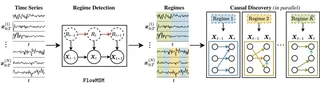
Temporal systems often exhibit non-stationary behaviour, such as seasonal climate variation or glucose fluctuations in patients with type-1 diabetes. One way to model non-stationarity is through discrete latent regimes, i.e., stationary segments of time. Such systems induce a Markov Switching Model (MSM), a class of Hidden Markov Models with autoregressive dependencies among latent regimes and observed variables. Identifying latent regimes is challenging in the presence of frequent regime switches and nonlinear and non-Gaussian dynamics, particularly when there are instantaneous effects between the variables, e.g., due to slow rates of measurements. In this work, we establish the identifiability of both latent regimes and regime-dependent causal structures under temporal regime dependencies, nonlinear lagged and instantaneous effects, and independent noise from the exponential family. Our identifiability theory subsumes non-temporal mixtures of causal models. Furthermore, we introduce FlowMSM, a regime detection framework that can be paired with any stationary causal discovery method to recover regime-dependent causal structures. Experiments on synthetic benchmarks and a financial economics dataset demonstrate the effectiveness of our approach to detect latent regimes and discover causal structures from non-stationary time series.
Type
Publication
Under submission
publications
Roel Hulsman
Authors
PhD Candidate in Causal Machine Learning

I am a second-year PhD candidate in causal machine learning at the Amsterdam Machine Learning Lab (AMLab), supervised by Sara Magliacane and Herke van Hoof. My PhD is funded by Adyen, a global financial technology company, where I spent a minor portion of my time. My research primarily focuses on causal methods for (nonstationary) time series, although I find myself broadly interested in the intersection of machine learning, statistics and econometrics, with a hint of philosophy.

I graduated with distinction from the University of Oxford with a MSc in Statisticial Science. While at Oxford, I was fortunate to be supervised by Rob Cornish and Arnaud Doucet for my dissertation on the mathematical guarantees of conformal prediction. I also graduated from the University of Groningen with a BSc in Econometrics and Operations Research and a BA in Philosophy of a Specific Discipline (in my case the social sciences), both cum laude.

Before starting my PhD, I spent a short period at ASML as a data analyst for business intelligence, where I optimised business processes for the manufacturing of lithography systems. Afterwards, I moved to a role in AI for healthcare at the Joint Research Centre (JRC) in Italy, an independent research institute of the European Commission. There, I mainly worked on conformal risk control for pulmonary nodule detection and knowledge graph construction using Large Language Models (LLMs).