On Constructing Biomedical Text-to-Graph Systems with Large Language Models

06 Dec 2024·
Lorenzo Bertolini
Roel Hulsman
Roel Hulsman
,
Sergio Consoli
,
Antonio Puertas Gallardo
,
Mario Ceresa
· 0 min read
Figure 1
Abstract
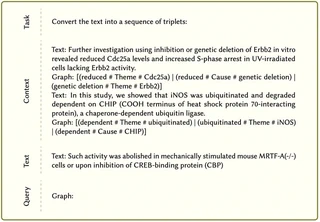
Knowledge graphs and ontologies represent symbolic and factual information that can offer structured and interpretable knowledge. Extracting and manipulating this type of information is a crucial step in complex processes such as human reasoning. While Large Language Models (LLMs) are known to be useful for extracting and enriching knowledge graphs and ontologies, previous work has largely focused on comparing architecture-specific models (e.g. encoder-decoder only) across benchmarks from similar domains. In this work, we provide a large-scale comparison of the performance of certain LLM features (e.g. model architecture and size) and task learning methods (fine-tuning vs. in-context learning (iCL)) on text-to-graph benchmarks in the biomedical domain. Our experiment suggests that, while a simple truncation-based heuristic can notably boost the performance of decoder-only models used with iCL, small fine-tuned encoder-decoder models produce the most stable and strong performance. Moreover, we found that a massive out-of-domain text-graph pre-training has a positive impact on fine-tuned models, while we observed only a marginal impact of pre-training and size for decoder-only iCL models.
Type
Publication
In Joint Proceedings of the 3rd International Workshop on Knowledge Graph Generation from Text (TEXT2KG) and Data Quality meets Machine Learning and Knowledge Graphs (DQMLKG), co-located with the Extended Semantic Web Conference (ESWC), volume 3747
publications
Roel Hulsman
Authors
PhD Candidate in Causal Machine Learning

I am a second-year PhD candidate in causal machine learning at the Amsterdam Machine Learning Lab (AMLab), supervised by Sara Magliacane and Herke van Hoof. My PhD is funded by Adyen, a global financial technology company, where I spent a minor portion of my time. My research primarily focuses on causal methods for (nonstationary) time series, although I find myself broadly interested in the intersection of machine learning, statistics and econometrics, with a hint of philosophy.

I graduated with distinction from the University of Oxford with a MSc in Statisticial Science. While at Oxford, I was fortunate to be supervised by Rob Cornish and Arnaud Doucet for my dissertation on the mathematical guarantees of conformal prediction. I also graduated from the University of Groningen with a BSc in Econometrics and Operations Research and a BA in Philosophy of a Specific Discipline (in my case the social sciences), both cum laude.

Before starting my PhD, I spent a short period at ASML as a data analyst for business intelligence, where I optimised business processes for the manufacturing of lithography systems. Afterwards, I moved to a role in AI for healthcare at the Joint Research Centre (JRC) in Italy, an independent research institute of the European Commission. There, I mainly worked on conformal risk control for pulmonary nodule detection and knowledge graph construction using Large Language Models (LLMs).